Selected observations and purchase advice
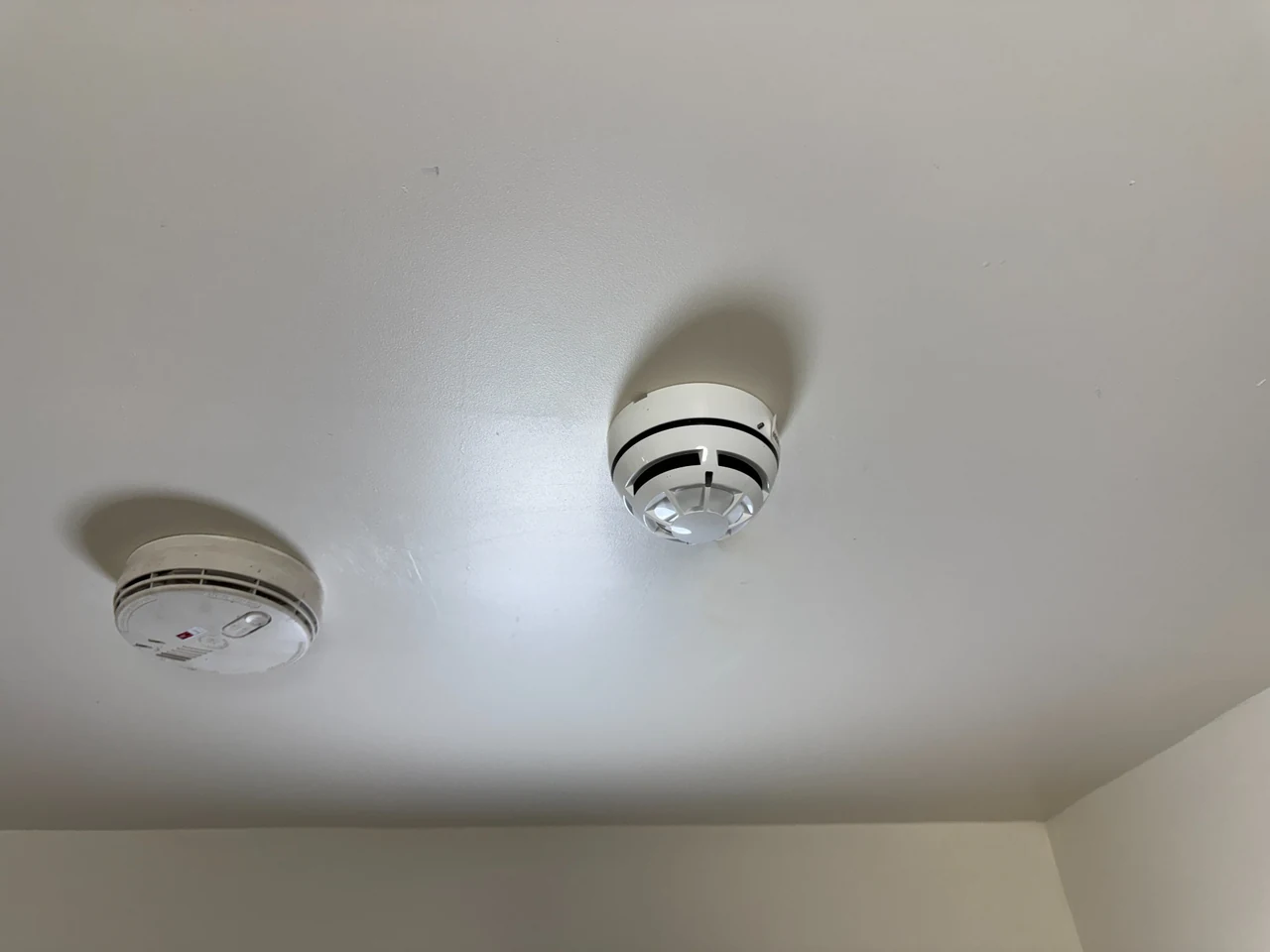
- The flat had domestic detection, while a further entrance hall heat detector was associated with the communal alarm arrangements.
- A displayed 'stay put' policy raised a question about how the communal alarm was intended to operate.
- The approved conversion arrangements, fire risk assessment and actual alarm operation needed to be understood before deciding whether either arrangement required change.
- The purchase survey flagged a potential inconsistency; it was not a fire risk assessment or a confirmed finding that the building was unsafe.
Where the private flat met the communal system
The flat had its own domestic smoke and heat alarms. Separately, the report identified an entrance hall heat detector associated with the communal system, with a panel and manual call points visible in the common areas. These were different provisions with potentially different functions.
A notice in the communal entrance described a 'stay put' policy. The issue arose at the boundary between the private accommodation and the shared system: what would activation inside this flat cause elsewhere in the building, and did that response agree with the instructions given to residents?
Which arrangement reflected the building’s fire strategy?
A 'stay put' strategy depends on the building providing suitable fire separation so that residents unaffected by a fire elsewhere can normally remain in their flats. A general alarm intended to prompt residents of multiple flats to leave would usually serve a simultaneous evacuation arrangement. If detection inside one flat produced that general warning, there would be a potential contradiction to resolve.
There were different possible explanations. The alarm arrangement might reflect an intended simultaneous evacuation strategy, making the 'stay put' information inappropriate. Alternatively, 'stay put' might be the correct strategy, raising questions about the purpose or configuration of the communal alarm. Understanding which detectors trigger which sounders or other equipment was essential: detection operating smoke ventilation is not the same as an alarm calling for general evacuation.
For a more recent conversion, the approved conversion design and intended standard of fire separation were important starting points, including any agreed departures from the usual arrangements. Conversion age alone could not prove that 'stay put' was suitable. The purchaser needed the relevant fire strategy, current fire risk assessment and alarm information to be obtained and reviewed, with the actual installation checked where necessary.
A purchase question beyond visible defects
The purchase survey did not test the alarm’s full operation or determine the building’s fire strategy. Its value was in recognising the potential inconsistency, explaining why it mattered and directing the purchaser towards the records and specialist clarification needed before accepting ownership.
In a small development, shared matters may be administered by the freeholder, a residents’ company or an appointed agent. Whatever the arrangement, the purchaser needed to establish who was responsible for the communal system, how formal or informal practices related to the lease, and how any necessary investigation or work would be arranged and funded.
The central concern was how the building functioned as a whole, including the interaction between communal equipment and the private accommodation. Service charge enquiries were relevant to dealing with that concern, but they were not the reason the alarm and evacuation arrangements warranted attention.
What this example illustrates
Good purchase advice considers how a flat functions within its wider building. Here, recognising a potential mismatch between a shared alarm system and the stated evacuation strategy revealed a question that a list of physical defects alone would not have answered.
These anonymised case studies are selective summaries of particular issues considered during individual inspections. They are not complete survey reports and do not reproduce every observation, limitation or recommendation. They describe findings at the inspection, not the property’s present condition. The content is for general information only and must not be relied upon as a survey, diagnosis, repair specification or professional advice for any property. Property-specific advice requires a separate instruction under agreed terms of engagement. Photographs may show equivalent features or inspection methods from other Riley James inspections.