
Reviewed 25 October 2026
Buying a property with missing building regulations paperwork
“It did not need planning permission” does not settle the building regulations position. When buying an altered property, establish the planning basis, the separate construction approval requirements and the evidence that the work was completed.
Permitted development does not remove any separate building regulations requirements. Planning permission, building control completion evidence and the physical condition of the work answer different questions.
Planning permission and building regulations: what is the difference?
These are separate systems. Establish what each required for the particular work, at the relevant date, before deciding whether the documents supplied are sufficient.
Planning permission
Planning deals with development and the use of land, including the size, appearance and position of an extension and its effect on neighbours and the surrounding area. A planning decision does not certify the technical quality of the construction.
Permitted development
Certain development has planning permission granted nationally, subject to conditions and limits, rather than requiring a full planning application. Prior approval may still be required for some work, and rights can be restricted. This planning route does not exempt controlled building work from building regulations.
Building regulations
Building regulations set technical requirements for construction, covering matters such as structural stability, fire safety, moisture resistance, ventilation, drainage, energy efficiency and access. The approval, inspection and certification route depends on the work; some installations can be certified through an appropriate competent person scheme.
A common example: a rear extension
An extension may qualify as permitted development while still requiring building regulations approval, inspections and appropriate completion evidence. A seller’s statement that “planning was not needed” leaves the building control question unanswered. The same distinction can matter with a loft conversion or internal structural alteration.
Which documents answer which question?
- Planning decision or lawful development certificate
- These concern the planning position. A lawful development certificate can establish that the described development is lawful for planning purposes; it is not a building regulations completion certificate.
- Building control records and completion evidence
- Ask for the application and the appropriate completion or final certificate for the work. Approval of plans concerns the proposed design and should not be confused with evidence relating to completed construction. For qualifying installations, the relevant competent person scheme certificate may be appropriate.
Ask your conveyancer to check both records against the work actually carried out. A survey assesses accessible physical condition within its scope; it does not issue retrospective approval or establish compliance of concealed work.
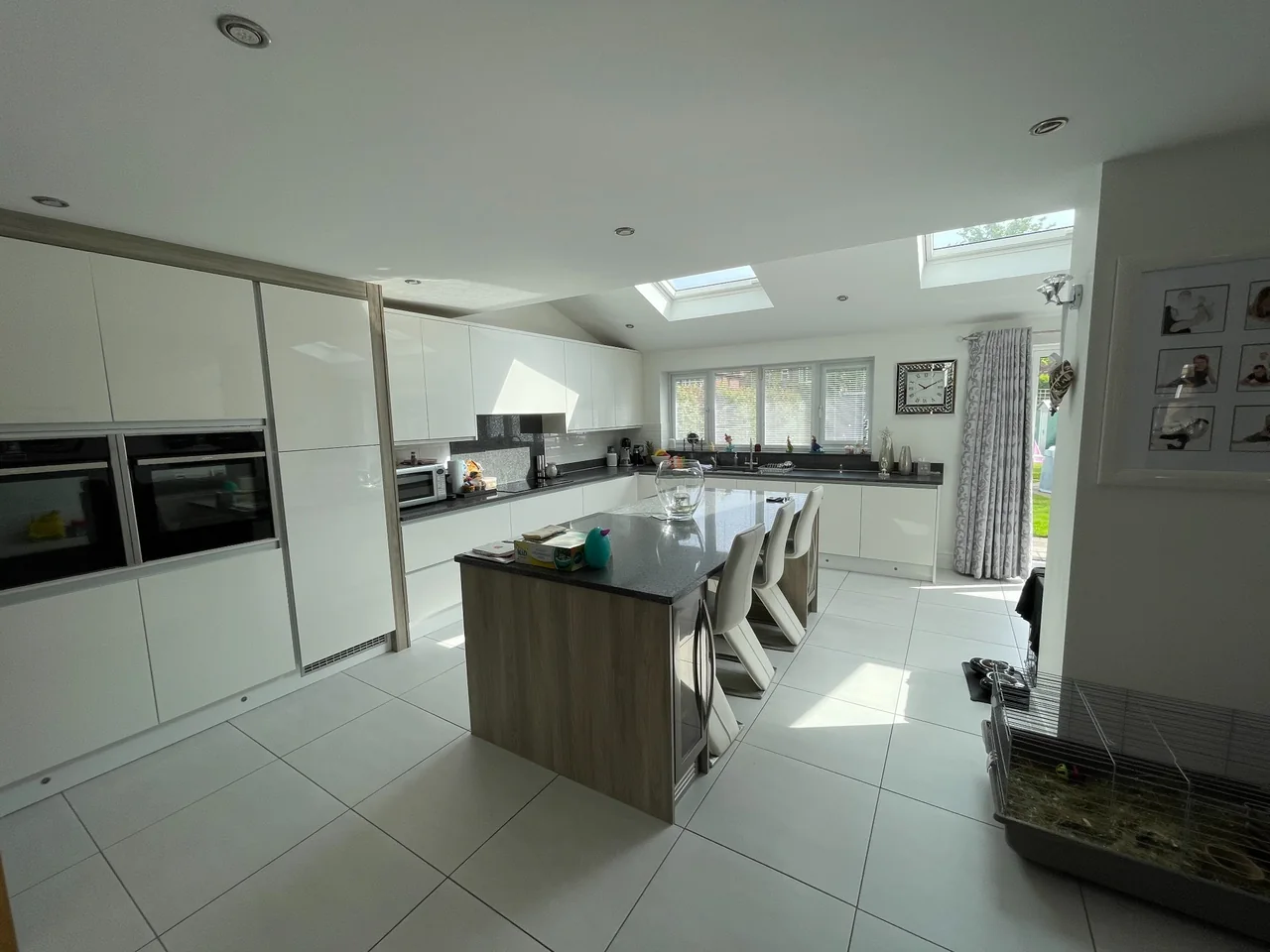
A kitchen extension with an island and rooflights, photographed during a survey.
Extensions and changes to internal layouts should be considered alongside the relevant planning and building control records. The finished appearance alone does not establish the construction details or certification available.
Work through the decision
Follow the four steps in order, or open the detail where you need a closer explanation.
- Step 1 of 4
Identify the alteration
Begin with what was built or removed and what can actually be inspected. Missing paperwork and poor construction are different questions.
Your next moveEstablish the nature and approximate date of the work.
Read the detail
Start with the work itself
Consider what was altered: a chimney breast removed below retained masonry, a load-bearing opening, a loft conversion, a rear extension or a converted outbuilding. A survey may identify suspect support, distortion, damp or other physical concerns even where finishes conceal parts of the structure.
An approval document does not substitute for the surveyor’s observations, and missing records do not establish that a particular alteration is dangerous. Determine which aspects of the work are visible and whether credible evidence of design and construction is available.
- Step 2 of 4
Clarify the missing evidence
A planning decision or permitted development explanation does not replace building control completion evidence. Check each documentary position against the actual work.
Your next moveAsk your conveyancer to identify the planning basis and the separate building regulations evidence expected for the work.
Read the detail
Check the planning and building control records separately
Ask the conveyancer to establish what permissions, building control applications, completion evidence, certificates from a competent person scheme and other documents would be expected for the work and the relevant date. Planning permission and building regulations are different controls, and certain works may also have implications for a listed building.
For unfinished conversions, establish the precise remaining work, conditions, intended lawful use and likely costs. An apparently completed room may not meet the buyer’s intended use without further work or evidence.
- Step 3 of 4
Understand what insurance covers
Indemnity insurance may address a defined legal risk. It does not establish the strength or condition of the building.
Your next moveAgree the enquiry sequence with your conveyancer before contacting an authority.
Read the detail
Indemnity insurance has a specific purpose
An indemnity policy may be offered to address particular legal enforcement risks where documentary evidence is missing. It does not prove structural adequacy, confirm compliance or automatically pay for defective construction. Cover scope, exclusions and whether successors can benefit depend on the actual policy wording.
Contacting the relevant authority may affect the availability of some indemnity policies, so the order of any enquiry should be decided with the conveyancer. The buyer should understand what the insurance does and does not address rather than assume a policy resolves the underlying physical question.
- Step 4 of 4
Consider the longer term decision
Further inspection, remedial work or regularisation may need consideration alongside the purchase and eventual resale.
Your next moveWeigh the physical condition, documentary gaps and likely next steps before exchange.
Read the detail
What about retrospective sign-off and resale?
For eligible work in England carried out without approval, a local authority regularisation process may be available, potentially involving exposure or alteration of the works. It is not guaranteed, and it does not apply indiscriminately to every historic alteration. The conveyancer should determine the legal route.
A future purchaser, insurer or lender may ask different questions or require additional evidence. A sensible decision before purchase weighs current condition, missing records, possible remedial works, intended use and how the property could be received when it is sold again.
Before you commit: buyer checklist
- Identify the exact alteration and when it was carried out.
- Separate visible construction concerns from the documentary position.
- Establish the planning basis, including any permitted development conditions.
- Check the separate building control approval and appropriate completion evidence.
- Understand any indemnity policy’s limits before relying on it.
- Consider future lending, insurance and resale consequences.
Professional guidance and official sources
These sources support the general guidance. Individual property advice depends on condition, location, scope and any current rules or lender requirements.
- GOV.UK: Building regulations approval and regularisation
- Planning Portal: Regularisation
- Planning Portal: Planning permission and building regulations explained
- GOV.UK: When building regulations approval is needed
- House of Commons Library: Permitted development in England
- GOV.UK: Lawful development certificates
General buyer information for England unless otherwise indicated; not legal advice, a report on a specific building or a substitute for independent conveyancing or lender requirements.
Buying a property with similar concerns?
Tell us what you know about the property, your proposed use and any issues already raised by the lender or seller.